- Startseite /
- Bücher /
- Engineering & Transportation /
- Engineering /
- Electrical & Electronics /
- Elektronik /
- Sensors /
- Autonomous Vehicle Lidar: A Tutorial
0 ratings

Artikelnr.:
41474947
Autonomous Vehicle Lidar: A Tutorial
Artikelnr.:
41474947
CHF 33
Price Details
Excluding Shipping & Custom charges ( Shipping and custom charges will be calculated on checkout )
*All items will import from USA
0 ratings
Schreiben Sie eine Bewertung
Auf Lager
 Vom USA Store für Sie importiert
QTY:
Bestellen Sie jetzt und erhalten Sie es am Mittwoch, August 05
Gesicherte Transaktion
Ubuy ist bestrebt, Ihre Sicherheit und Privatsphäre zu schützen. Unser fortschrittliches Zahlungssicherheitssystem gewährleistet Vertraulichkeit, indem Ihre Daten während der Übertragung mit AES (Advanced Encryption Standards) und SSL (Secure Socket Layer) Protokollen verschlüsselt werden. Ihre Zahlungsdaten sind 100% sicher, da wir Ihre Zahlungsdaten nicht an Drittanbieter weitergeben.
Unsere besten Logistigpartner


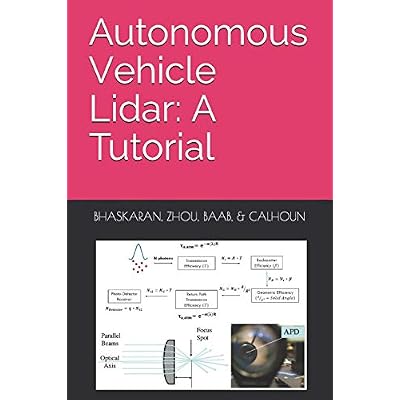
This tutorial text aims to introduce a technical but nonspecialist reader to autonomous vehicle lidar, starting from the fundamental physics of lidar and motivation for its application to autonomous vehicle systems.

Fast
Shipping

Kostenlose
Rücksendung*

Sichere Verpackung

100 % Originalprodukte

PCI DSS-Standards

ISO 27001-zertifiziert


Note: Step Down Voltage Transformer required for using electronics products of USA store (110-120). Recommended power converters Jetzt kaufen.


Besondere Merkmale
Enhanced Accuracy
Offers precise environmental mapping using advanced laser technology, ensuring reliable navigation and obstacle detection, which significantly improves safety in autonomous vehicles.
Real-time Processing
Processes data instantly to allow vehicles to adapt to changing surroundings, enabling immediate responses to dynamic driving conditions and enhancing overall driving intelligence.
Benutzerfreundliche Oberfläche
Designed with accessibility in mind, providing intuitive controls and clear visualizations for developers, making it simpler to integrate and operate within autonomous systems.
Produktdetails
| Artikelgewicht | 680 Gramm |
Für wen ist das Produkt geeignet?

-
Engineering Students
Students pursuing degrees in engineering can gain foundational knowledge on LIDAR technology used in autonomous vehicles.
-
Industry Professionals
Professionals in automotive and robotics sectors can enhance their understanding of LIDAR applications and integration techniques.
-
Hobbyist Developers
Independent developers and hobbyists interested in DIY autonomous projects will find useful insights and practical examples in this tutorial.

-
General Consumers
Everyday consumers seeking basic information about autonomous vehicles may find this tutorial overly technical and complex.
PRODUKTBESCHREIBUNG
Autonomous Vehicle Lidar: A Tutorial
Haben Sie eine Frage? Mit uns chatten
Kunden Fragen und Antworten
-
Frage:
What is Lidar and how does it work in autonomous vehicles?
Antworten: Lidar, which stands for Light Detection and Ranging, is a technology that uses laser light to measure distances. In autonomous vehicles, Lidar systems emit pulses of laser light and measure the time it takes for the light to reflect off objects and return. This process creates a precise 3D map of the vehicle's surroundings, allowing it to detect obstacles, lane markings, and other vital features necessary for safe navigation. -
Frage:
What are the key benefits of using Lidar in autonomous vehicles?
Antworten: The main benefits of Lidar include high precision, long-range detection, and the ability to create detailed 3D representations of the environment. This accuracy enables autonomous vehicles to make informed decisions in real time, enhancing safety and efficiency. Additionally, Lidar can operate effectively in various lighting conditions, unlike traditional cameras that may struggle at night or in bright sunlight. -
Frage:
How does Lidar compare to other sensors used in autonomous vehicles?
Antworten: Lidar offers distinct advantages over other sensors like radar and cameras, particularly in terms of spatial resolution and object detection capabilities. Unlike cameras, Lidar collects accurate distance information, which is crucial for identifying and categorizing objects. Radar, while robust in detecting objects, lacks the fine detail that Lidar provides, thus making Lidar a preferred choice for comprehensive environmental mapping. -
Frage:
Can Lidar systems be affected by weather conditions?
Antworten: Yes, Lidar systems can be impacted by adverse weather conditions, especially heavy rain, fog, or snow. These conditions can scatter the laser light, reducing detection accuracy. However, advancements in Lidar technology are continually being developed to enhance performance in less than optimal weather scenarios, making systems more reliable in various environments, ultimately improving safety for autonomous driving. -
Frage:
What types of Lidar systems are commonly used in autonomous vehicles?
Antworten: There are two primary types of Lidar systems: solid-state Lidar and mechanical Lidar. Solid-state Lidar uses electronic components to scan the environment, offering simpler, more compact designs with reduced moving parts. Mechanical Lidar, on the other hand, employs rotating mirrors or similar technology to achieve a complete field of view. Each type has its advantages, so manufacturers select based on specific applications and desired performance characteristics. -
Frage:
What role does Lidar play in the development of self-driving cars?
Antworten: Lidar plays a critical role in the development of self-driving cars by enabling these vehicles to perceive their surroundings accurately. This capability is crucial for tasks like obstacle detection, lane keeping, and navigation. Manufacturers rely on the data generated by Lidar systems to refine their algorithms and improve the overall efficiency and safety of autonomous driving technologies, ensuring a seamless driving experience. -
Frage:
How is data from Lidar processed for vehicle navigation?
Antworten: Data from Lidar is processed using sophisticated algorithms that analyze the 3D point clouds generated. This involves filtering noise, identifying objects, and determining distances. The processed data is then integrated with information from other sensors, such as cameras and radar, to create a cohesive understanding of the vehicle's environment. This integration allows autos to navigate safely and efficiently through various driving conditions. -
Frage:
What are the limitations of Lidar technology in autonomous driving?
Antworten: While Lidar is robust, it does have limitations. Its effectiveness can decrease in certain weather conditions, and it may struggle to recognize certain materials or objects that do not reflect laser light effectively. Additionally, there is a significant cost associated with high-quality Lidar systems, which can be a barrier to widespread adoption in lower-cost vehicle models. Despite these challenges, ongoing research continues to enhance Lidar technology. -
Frage:
Can Lidar be integrated with other technologies for enhanced vehicle performance?
Antworten: Yes, integrating Lidar with other technologies like cameras, radar, and artificial intelligence (AI) enhances overall vehicle performance. This fusion of data allows for a more comprehensive perception of the environment, addressing the individual limitations of each technology. Such integration is essential to the advancement of autonomous systems, enabling vehicles to make informed decisions during complex driving scenarios. -
Frage:
Where can I buy Autonomous Vehicle Lidar: A Tutorial in Liechtenstein?
Antworten: You can purchase Autonomous Vehicle Lidar: A Tutorial at Ubuy. They offer a wide selection of educational and technical resources, ensuring you can find the right materials for your needs. Ubuy stands out for its user-friendly platform and reliable customer service, making it a preferred option for acquiring specialized items in your Liechtenstein.
Sensors Editorial Review
Keine redaktionellen Rezensionen gefunden
Kundenbewertungen
1 Kundenbewertungen
-
5 Sterne
100%
-
4 Sterne
0%
-
3 Sterne
0%
-
2 Sterne
0%
-
1 Sterne
0%
Bewerten Sie dieses Produkt
Teilen Sie Ihre Meinung mit anderen Kunden
Platform Trust & Buyer Confidence

MA
Mohammad
Verified buyer
“Excellent quality and original too,when ubuy send original things I will appreciate that ,I very satisfied thank you”
23 July 2026 · via Trustpilot
CK
Chitra
Verified buyer
“The order and delivery progress was communicated very well. Package arrived within the estimated time. Products arrived as expected in good condition.”
22-Jul-26 · via Trustpilot
K
kund
Verified buyer
“Good supply of products. Safe payment methods, and shipment worldwide! Genuine products.”
23-Jul-26 · via Trustpilot
OO
Onesi
Verified buyer
“Was my first time buying a product from Ubuy, but I found it so helpful. This is reliable. Gonna place a new order!”
22 July 2026 · via Trustpilot
SJ
SAO JOHN
Verified buyer
“Ubuy is a great online platform to buy stuff. Reliable, fast delivery time and great value for money. I've been using Ubuy online shopping platform for three years now and will continue to do so.”
23 July 2026 · via Trustpilot
Sicheres Bezahlen
Global Delivery
Einfache Rückgabe
Genuine Products
Produktpreisverlauf
Wichtige Information
- Einschränkungen: Für international versandte Produkte beachten Sie bitte, dass jegliche Herstellergarantie nicht gültig sein könnte; Herstellerservice-Optionen nicht verfügbar sein könnten; Produkthandbücher, Gebrauchsanleitungen und Sicherheitshinweise nicht in der Sprache des Ziellandes verfasst sein könnten; die Produkte (und Begleitmaterialien) könnten nicht im Einklang mit den Standards, Spezifizierungen und Etikettierungsvorgaben des Ziellandes entworfen sein; und die Produkte könnten nicht der Voltzahl und anderen elektrischen Standards des Ziellandes entsprechen (weshalb, falls zutreffend, die Verwendung eines Adapters oder Umwandlers erforderlich sein könnte). Der Empfänger ist dafür verantwortlich sicherzustellen, dass das Produkt legal in das Zielland importiert werden kann. Bei der Bestellung von Ubuy oder seinen Partnern ist der Empfänger der eingetragene Importeur und muss sich an alle Gesetze und Regulierungen des Ziellandes halten.
- Nicht alle auf Ubuy aufgeführten Produkte werden zum Verkauf angeboten, da Ubuy eine globale Suchmaschine ist. Produkte unterliegen Export-/Handelsbestimmungen.
CHF 33
Bestellen Sie jetzt und erhalten Sie es am Mittwoch, August 05
Dieser Artikel unterliegt in meinem Land keinen Beschränkungen. (Klicken Sie bitte auf den obigen Link, wenn dieser Artikel in Ihrem Land keinen Beschränkungen unterliegt. Unser Team wird ihn dann prüfen und zulassen.)
QTY:
Gesicherte Transaktion
PCI DSS compliant and ISO 27001:2022 certified, with encrypted payments and full buyer protection on every order.
Unsere besten Logistigpartner
Schnellste grenzüberschreitende Lieferung
Merkmale und Vorteile
- Comprehensive introduction to autonomous vehicle lidar.
- Covers fundamental physics and applications of lidar technology.
- Explores time of flight design concepts in detail.
- Discusses beam steering and timing methods.
- Designed for both technical readers and non-specialists.
- Prepares readers for laboratory explorations in the field.
Ubuy Assurance
Experience worry-free shopping with 100% original products, PCI DSS-compliant payment security, ISO 27001-certified data protection, the fastest cross-border delivery, free returns *, and secure packaging on every order.